Kul’tirans allied with Alliance: Keep prisoners in shitty conditions, but still alive.
Horde: *Plagues everything in existence* what’s a prisoner. Oh, the things we used as target practice and to feed our animals. Yea, we just poison them and bring them back as undead now.
Some of you people: They’re clearly both morally grey and both bad equally.
Yeah I really love the fact that in the prison at proudmoore acadamy they use an undead as target practice and use prisoners for forced labour. And let’s not forget child labour in the ashvane factory 😉 It’s not as nuanced as grey as I would like, but there are still a few things that are fishy
Child labour in Ashvane factory is as far as I know from questing/the storyline completely unrelated to the Kul’tiran faction that allies with the Alliance considering Ashvane tries to take over Kul’tiras and isn’t allied with the Alliance.
It’s a troll being threatened at a target practice location. He’s not target practice. If they wanted to use him as target practice they’d tie him up to the target like Horde did, or just remove the target practice and you’d actively see them kill him.
Like I said,
Keep prisoners in shitty conditions. The Alliance morally grey is about as grey as a light rain cloud.
So I feel like a lot of confusion with drawing in perspective is because people are not taught the absolute basics properly? So let’s do that.
Let’s say we have a cube.
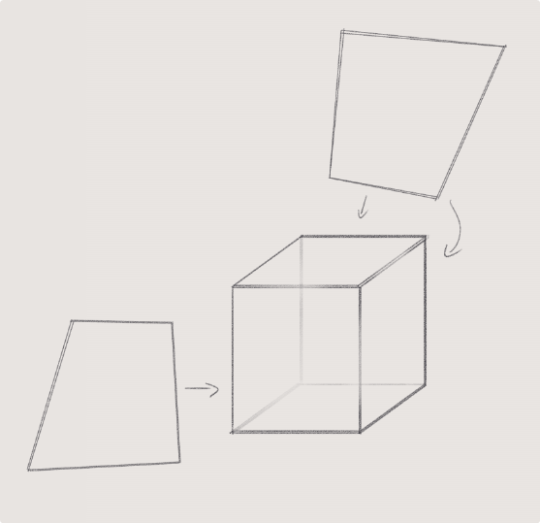
Now, a cube we know is made out of 6 squares or rectangles, and every edge is at a 90 degree angle.
so every opposite edge of a cube is exactly parallel, right?
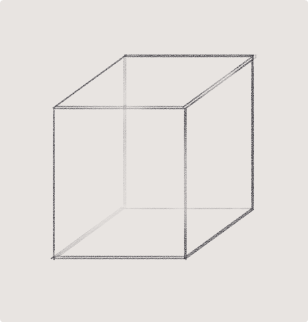
but let’s say we draw a cube using only parallel lines:
this looks a little weird, you know? Like if i try think of this as an object in 3d space and i look at it for too long, the faces start to look really warped – with like the back looking bigger than the front as if its been made out of weird wonky trapeziums
so what’s going on here? if all those edges are exactly parallel, why does it look weird?
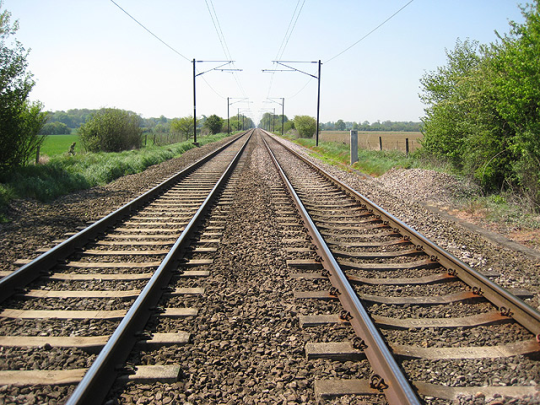
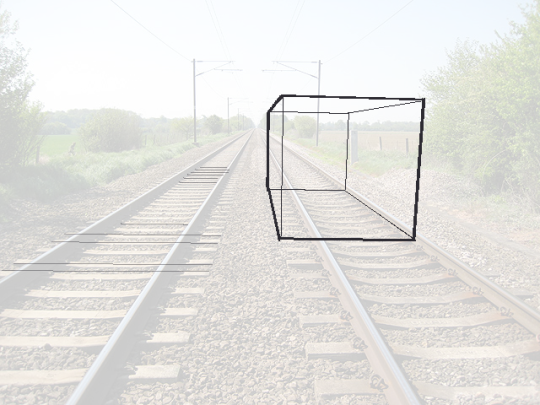
Now we know that the rails on a track are always going to be parallel, they have to be the same distance apart so the train can stay on the track yeah?
But we can very clearly see that these tracks are converging to a single point in the photo.
So what does this tell us, exactly? That our view of the world is naturally warped, and that lines that are physically parallel when drawn in perspective will converge to a single point.
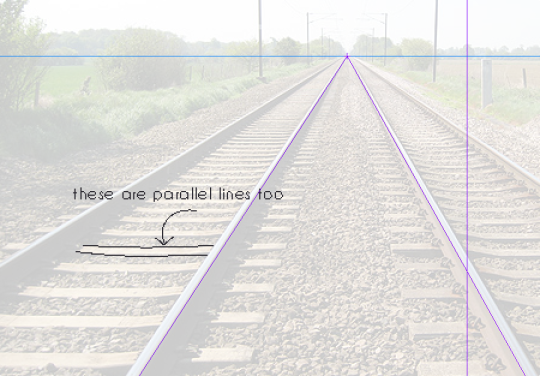
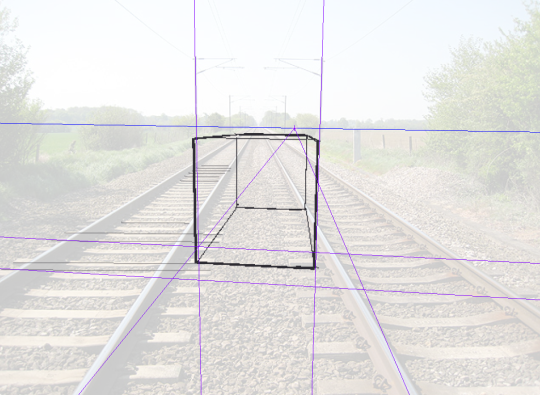
Now, I could call this image “one point perspective” – but that’s not really true,
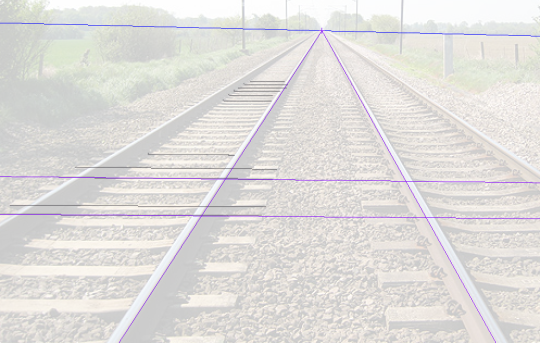
if these lines are also parallel, then they must also converge to a single point in perspective, right? so lets add another point
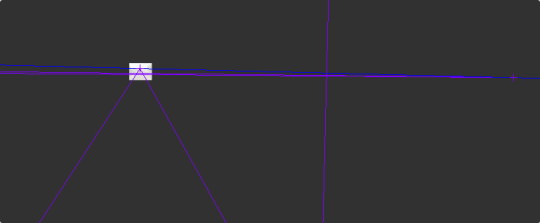
clip studio paint automatically adjusts the horizon line to fit the new points you add to your perspective…. notice how the horizon line actually fits the photo better now?
our new point is a very very long way away, so we don’t notice a lot of difference in the angle between lines, but the point that i’m trying to make here is:
Drawing with perspective guides is not about choosing one, two, three point perspective etc. those are just quick ways to set up a certain viewing angle
What you are doing when you use these guides is making your parallel lines converge to a point.
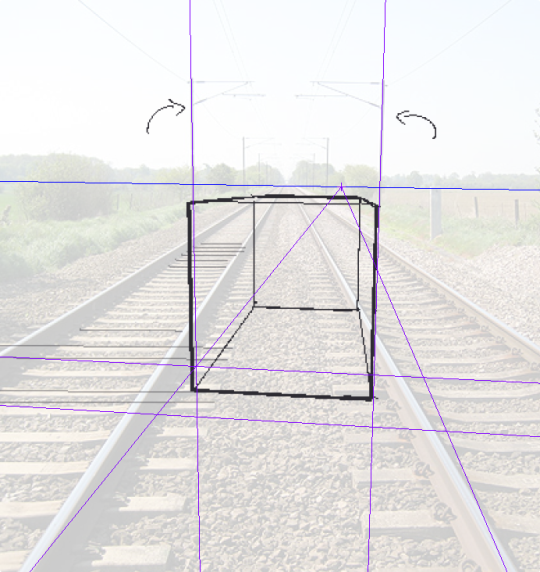
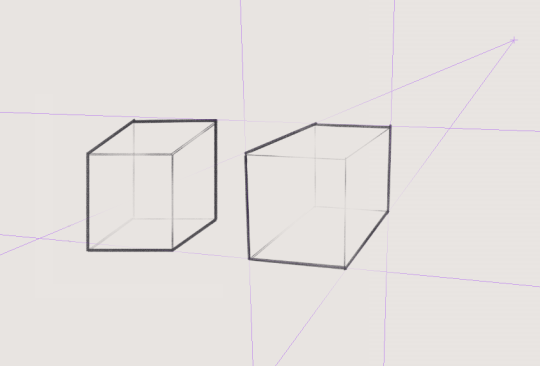
So, if you want to draw a big ol’ cube that’s aligned to be parallel with these railroad tracks, then you can do that with the same point as the tracks – because it’s parallel. It’s on the same axis!
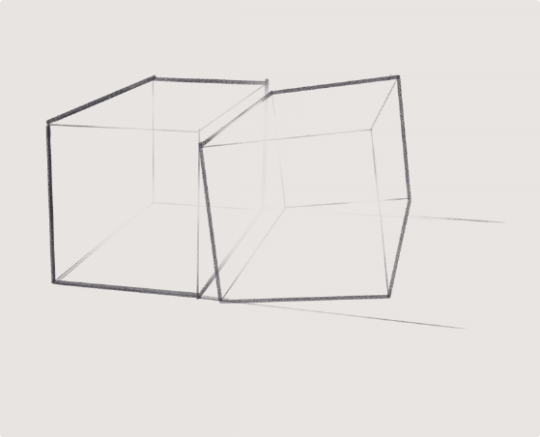
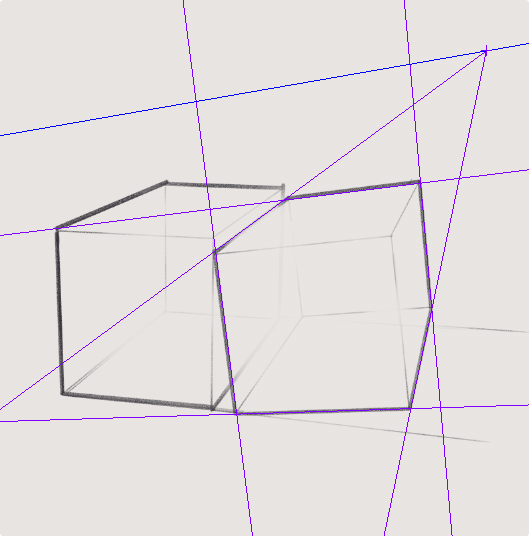
but what if you want to draw a cube that’s rotated, and isn’t parallel to the tracks?
well that’s not too difficult to do if you know that every point represents one set of parallel lines.
If these lines aren’t parallel to the ones you already have, then clearly you just need new points.
We’re not planning to tilt this cube up into the air, or rotate it onto its side, so we’re going to leave the vertical axis alone, and just move our horizontal points to a different place on the horizon line
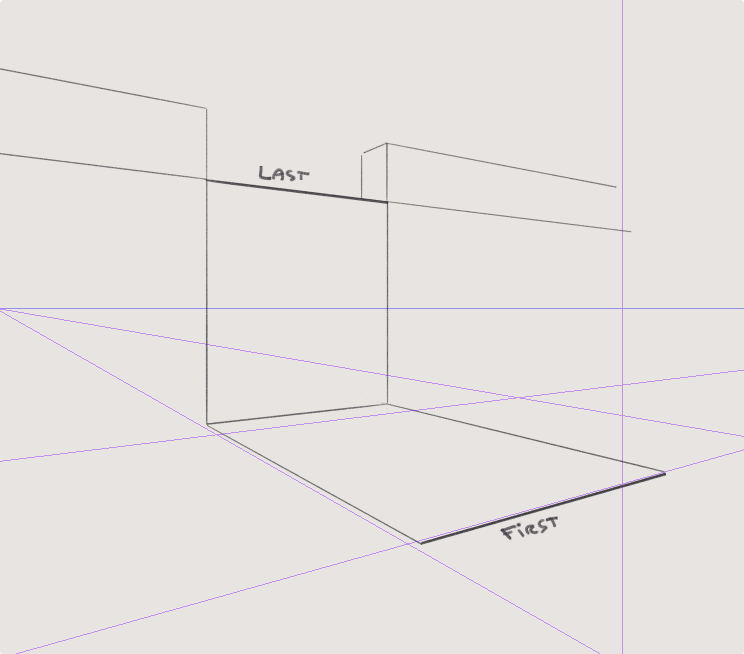
But speaking of the vertical axis – the only points that will be on your horizon line are the ones that are flat on the ground. But you can still have points that are not on the horizon line!
This is important to remember because if you’re trying to draw something like a slope or stairs, something that has an incline, it’s not going to be level with your horizon.
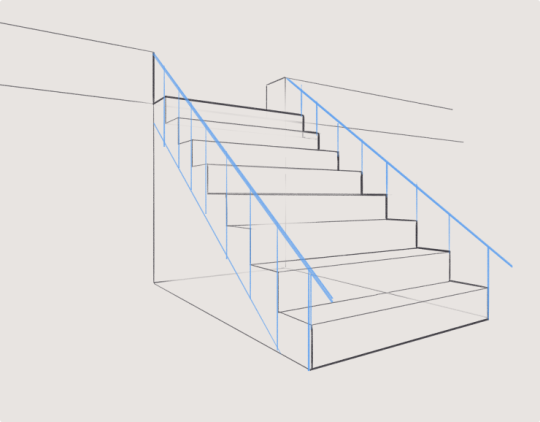
Let’s draw some stairs as an example.
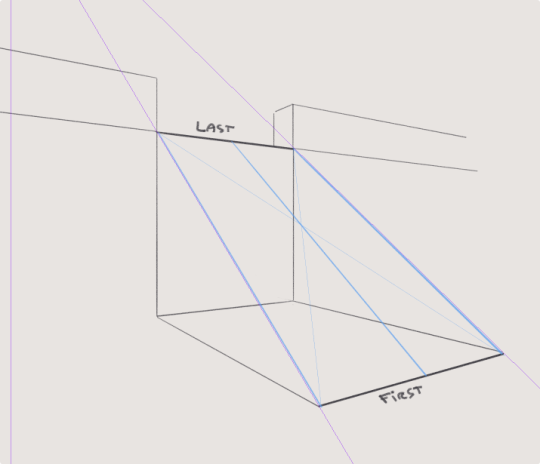
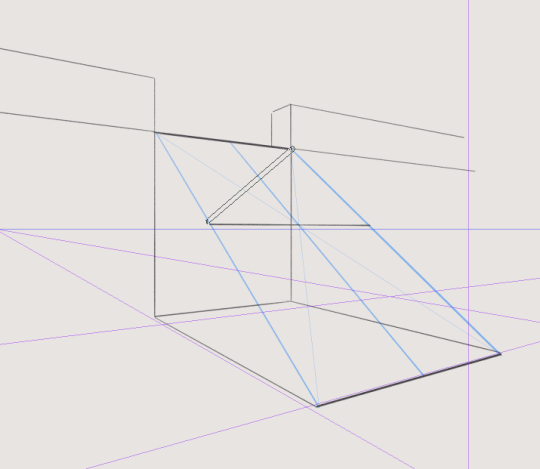
This is actually pretty simple – first draw where your slope starts and ends by drawing a big L shape.
this will give you some parallel corners, which you can then connect to make a new point for your slope





 Wolfytot