alicekaninchenbau:

gingerkodama:

alicekaninchenbau:

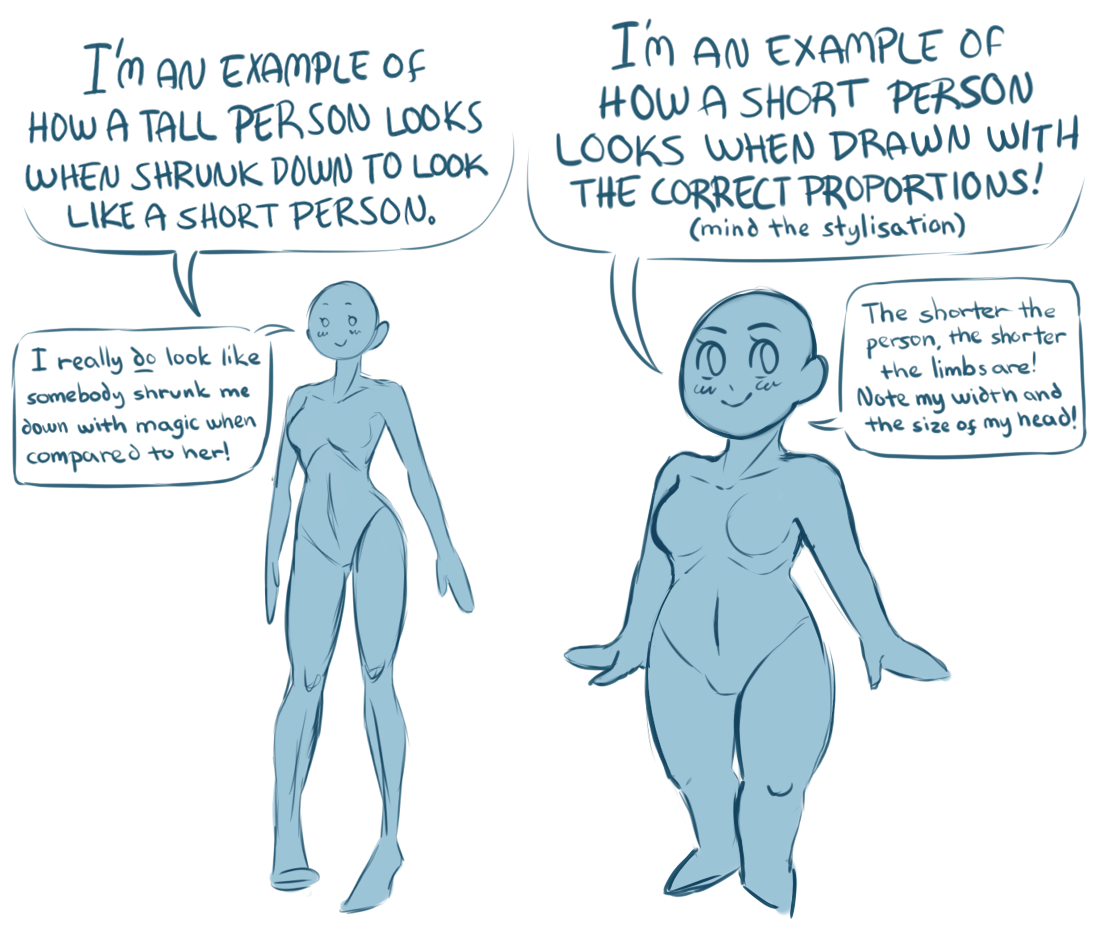
PLEASE NOTE: The art is very anatomically inaccurate in both of these sketches as it’s very cartoony/stylized. The point of it is to showcase the main difference between a very short and a very tall adult person to help learning artists get at least some kind of a basic idea on how to draw short people, and help them avoid unintended erasure of short people and people with dwarfism. But like with all art, always look for proper photos and other references to learn to draw short people in an anatomically accurate way. This is only a tip and a reminder on a mistake I see way too often (/looks at all this fanart of Amethyst from Steven Universe and gets extremely sad)

So to recap and better explain my points:

  • You can’t draw an average height-person and then just resize the drawing to make them shorter- they’ll look like somebody shrunk them with magic instead of being actually short
  • Drawing a shorter person means that they’ll have shorter limbs. Whether they’re only slightly shorter than average, a lot shorter than average or a person with dwarfism does however affect how much shorter those limbs and other body parts (head, hands, feet) are.
  • While the limbs (arms, legs, spine) are shorter, the limbs don’t get skinnier or thinner (much;; again, depends on how much shorter they are, as well as their weight/BMI. The difference between underweight and overweight is a lot smaller with shorter people than taller people!)
  • Short people can still have different bodytypes- some are curvier, some are more muscular, some are like bananas, some like potatoes. (In the picture we had cartoonishly curvy people, most people aren’t going to be that curvy though and it’s okay)
  • THERE ARE EXCEPTIONS!!! Pygmy people for example.

Did you get all that? Now go, do some research, and go draw some beautiful short human beings you wonderful artist! I BELIEVE IN YOU! ♥♥♥

(ノ゚∀゚)ノ :。・:*:・゚’★,。・:*:♪・゚’☆━━!!!

I feel I must put my input to spread a little dwarfism awareness!

There is such a thing as proportionate dwarfism and primordial dwarfism. These can be the result of hormonal imbalances or genetic mutations.
This leads the affected individual to be dwarfed yet just as ‘proportionate’ as somebody who is 6ft.
For example there is Growth Hormone Deficiency, Russell Silver Syndrome (which I have), MOPD, 3M Syndrome etc.

Then you have disproportionate dwarfism.
This is when bone growth is affected. The most common form of disproportionate dwarfism is achondroplasia where the cartilage doesn’t form to bone properly. There are all sorts of disproportionate dwarfisms. Some affect the limbs (like achondroplasia), while others can affect the torso etc.

I am just really tired of people telling me that I am not a dwarf because I am proportionate. I have a genetic mutation. I am a totally miniature version of a regular sized human.
Just because you don’t see people such as myself often, does not mean it doesn’t happen.

I really appreciate your art, I think it is lovely and I love that you are spreading awareness of how some short people are built differently but please please please understand and be aware that shrunk-in-the-wash little people happen.

Oh you weren’t rude at all! That was a very good debunk/disclaimer you added that people should know about, including me— I’m no expert on the different forms of dwarfism (as you could probably tell). This was sort of just a passive aggressive rant (on how fanartists draw a specific character) that I tried to turn into something a little bit more productive and helpful. And I did add a tiny note about how there are exceptions to my tip, but yeah, I should’ve done a little bit more research and done a more well-thought-out and accurate tutorial.

I’m sorry I spread harmful misinformation, especially on a subject that’s very close to my heart too. I won’t half-ass this again, I’ll do my research properly so that others won’t have to correct my mistakes and do my research for me.


Architect Personality (INTJ, -A/-T) 

“You are not entitled to your opinion. You are entitled to your informed opinion. No one is entitled to be ignorant.” –Harlan Ellison

It’s lonely at the top, and being one of the rarest and most strategically capable personality types, Architects know this all too well. Architects form just two percent of the population, and women of this personality type are especially rare, forming just 0.8% of the population – it is often a challenge for them to find like-minded individuals who are able to keep up with their relentless intellectualism and chess-like maneuvering. People with the Architect personality type are imaginative yet decisive, ambitious yet private, amazingly curious, but they do not squander their energy.

With a natural thirst for knowledge that shows itself early in life, Architects are often given the title of “bookworm” as children. While this may be intended as an insult by their peers, they more than likely identify with it and are even proud of it, greatly enjoying their broad and deep body of knowledge. Architects enjoy sharing what they know as well, confident in their mastery of their chosen subjects, but they prefer to design and execute a brilliant plan within their field rather than share opinions on “uninteresting” distractions like gossip.

A paradox to most observers, Architects are able to live by glaring contradictions that nonetheless make perfect sense – at least from a purely rational perspective. For example, Architects are simultaneously the most starry-eyed idealists and the bitterest of cynics, a seemingly impossible conflict. But this is because Architect personalities tend to believe that with effort, intelligence and consideration, nothing is impossible, while at the same time they believe that people are too lazy, short-sighted or self-serving to actually achieve those fantastic results. Yet that cynical view of reality is unlikely to stop an interested Architect from achieving a result they believe to be relevant.

Architects radiate self-confidence and an aura of mystery, and their insightful observations, original ideas and formidable logic enable them to push change through with sheer willpower and force of personality. At times it will seem that Architects are bent on deconstructing and rebuilding every idea and system they come into contact with, employing a sense of perfectionism and even morality to this work. Anyone who doesn’t have the talent to keep up with Architects’ processes, or worse yet, doesn’t see the point of them, is likely to immediately and permanently lose their respect.

Rules, limitations and traditions are anathema to the Architect personality type – everything should be open to questioning and reevaluation, and if they see a way, Architects will often act unilaterally to enact their technically superior, sometimes insensitive, and almost always unorthodox methods and ideas.
This isn’t to be misunderstood as impulsiveness – Architects will strive to remain rational no matter how attractive the end goal may be, and every idea, whether generated internally or soaked in from the outside world, must pass the ruthless and ever-present “Is this going to work?” filter. This mechanism is applied at all times, to all things and all people, and this is often where Architect personalities run into trouble.

Architects are brilliant and confident in bodies of knowledge they have taken the time to understand, but unfortunately the social contract is unlikely to be one of those subjects. White lies and small talk are hard enough as it is for a type that craves truth and depth, but Architects may go so far as to see many social conventions as downright stupid. Ironically, it is often best for them to remain where they are comfortable – out of the spotlight – where the natural confidence prevalent in Architects as they work with the familiar can serve as its own beacon, attracting people, romantically or otherwise, of similar temperament and interests.

Architects are defined by their tendency to move through life as though it were a giant chess board, pieces constantly shifting with consideration and intelligence, always assessing new tactics, strategies and contingency plans, constantly outmaneuvering their peers in order to maintain control of a situation while maximizing their freedom to move about. This isn’t meant to suggest that Architects act without conscience, but to many other types, Architects’ distaste for acting on emotion can make it seem that way, and it explains why many fictional villains (and misunderstood heroes) are modeled on this personality type.